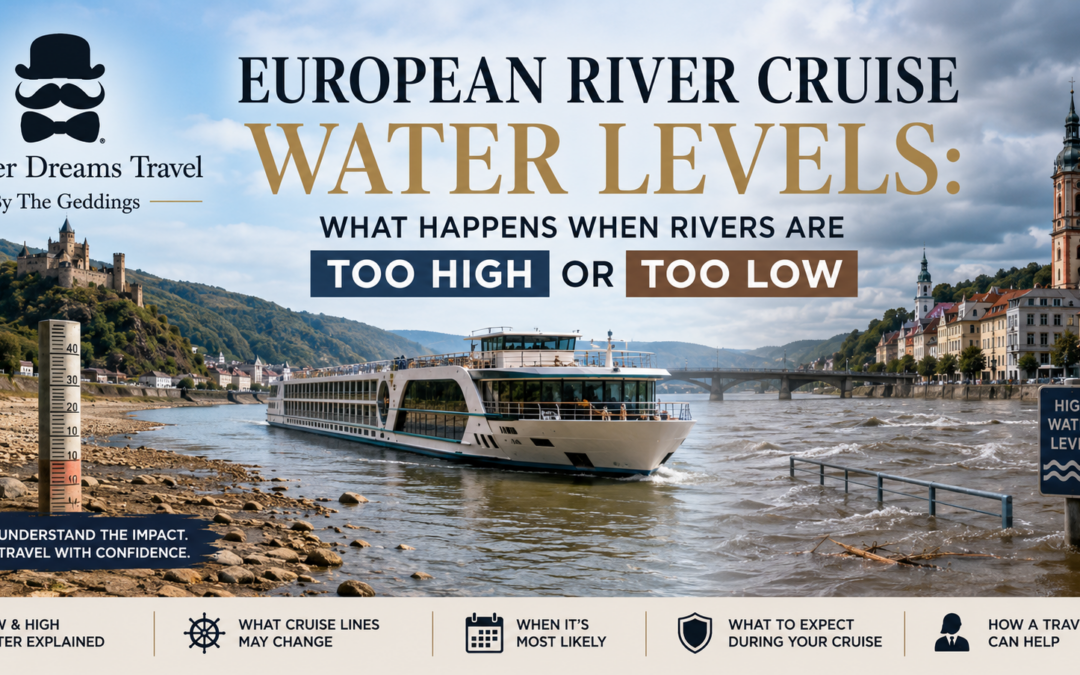
River cruising offers one of the most relaxing ways to explore Europe. Travelers can unpack once, sail through scenic countryside, and step ashore near the heart of historic cities and charming villages.
Unlike an ocean cruise, however, a river cruise operates on a relatively narrow and constantly changing waterway. Rainfall, snowmelt, prolonged heat, drought, locks, bridges, and currents can all influence whether a river cruise ship can safely navigate a particular section of the river.
During July 2026, unusually hot and dry conditions across Europe have brought renewed attention to water levels on the Rhine and Danube, the two rivers many travelers choose for their first European river cruise.
On July 16, 2026, the Danube in Budapest was measured just eight centimeters, or a little more than three inches, above the record low recorded in 2018. Several vessels were delayed or waiting in port, and Avalon Waterways confirmed that it had canceled a small number of upcoming Rhine and Danube departures.
Farther downstream in Romania, the Danube reached its lowest level in approximately 30 years. River flow was reported at about 1,700 cubic meters per second, compared with a typical July average of approximately 4,700 cubic meters per second.
The Rhine has also experienced sharply reduced water levels. Shallow conditions have forced many cargo vessels to operate with substantially lighter loads, illustrating how dramatically low water can affect navigation.
These reports understandably concern travelers with an upcoming river cruise. However, they do not mean that every ship, every itinerary, or every section of the Rhine and Danube is closed.
Water levels can vary considerably from one location to another. A ship may navigate most of an itinerary normally while encountering difficulty along only one particular stretch of river. Conditions can also change quickly after rainfall upstream.
Most importantly, significant water-level disruptions remain relatively uncommon. Industry estimates generally suggest that water levels affect approximately 5 to 10 percent of river cruises, frequently for only a limited portion of the itinerary. Using the midpoint of that range, it is reasonable to say that roughly 8 percent of cruises may experience some type of water-related modification, although river cruise companies do not collectively publish one comprehensive industry-wide statistic.
For travelers who want to experience France at a slower, more meaningful pace, the Seine is one of Europe’s most rewarding river cruise itineraries.
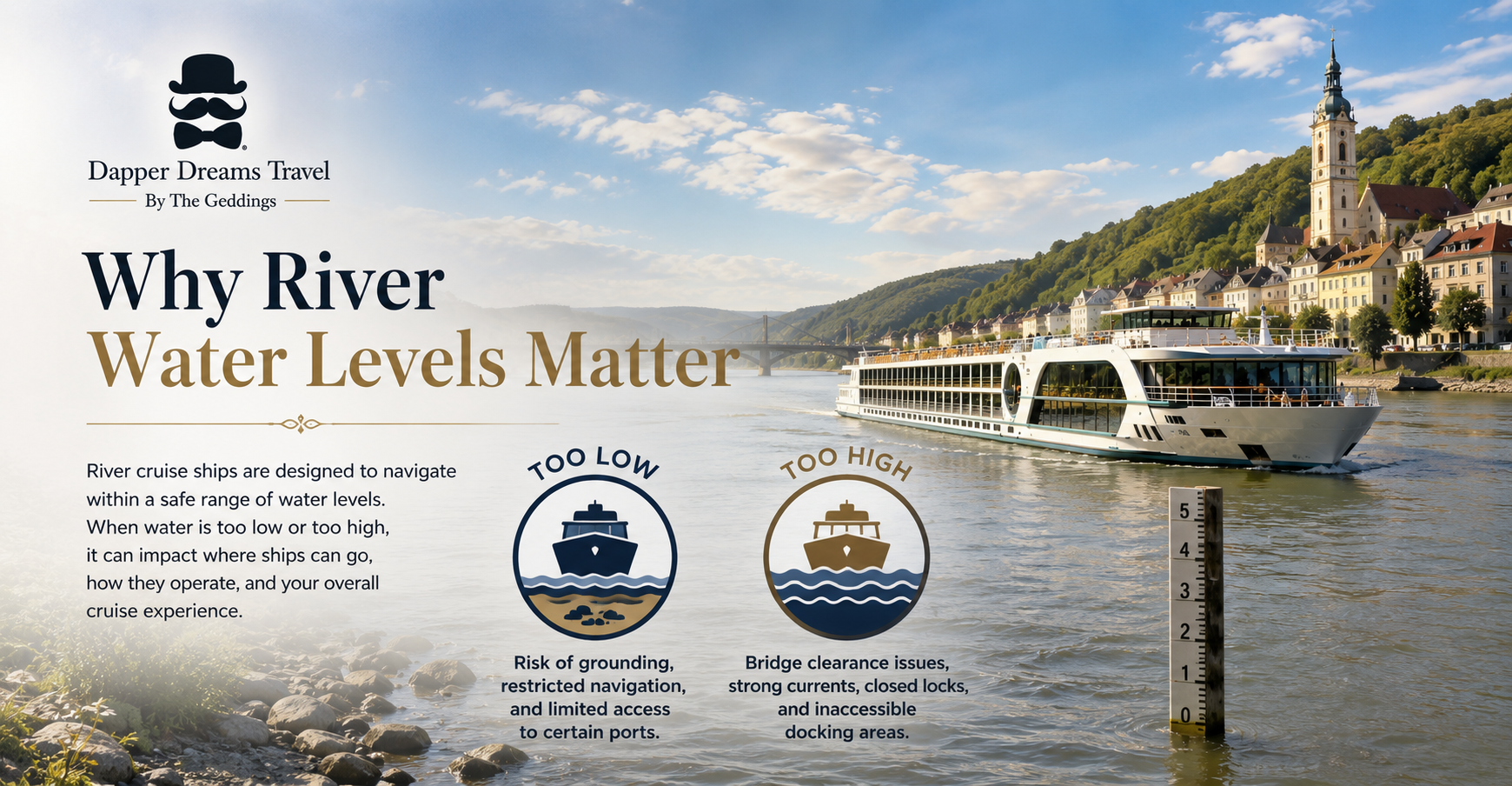
Every river cruise ship has a maximum height and a minimum amount of water it needs to navigate safely.
When the river is too low, the ship’s draft, or the depth of the vessel below the waterline, becomes the primary concern. The captain must have enough clearance between the bottom of the ship and the riverbed.
When the river is too high, the challenge is often above the ship. A vessel may no longer fit safely beneath bridges. High water can also create stronger currents, cover docking facilities, close locks, or make certain ports unsafe to access.
River cruise lines continuously monitor official river gauges, weather forecasts, lock operations, bridge clearances, and information provided by local navigation authorities. Decisions are based on the conditions affecting a specific ship and itinerary, not simply a general headline stating that the Rhine or Danube is low or high.
Cargo vessels, sightseeing boats, and passenger cruise ships may also have different operating limitations. A report that cargo ships are reducing their loads does not automatically mean that every river cruise has stopped operating.
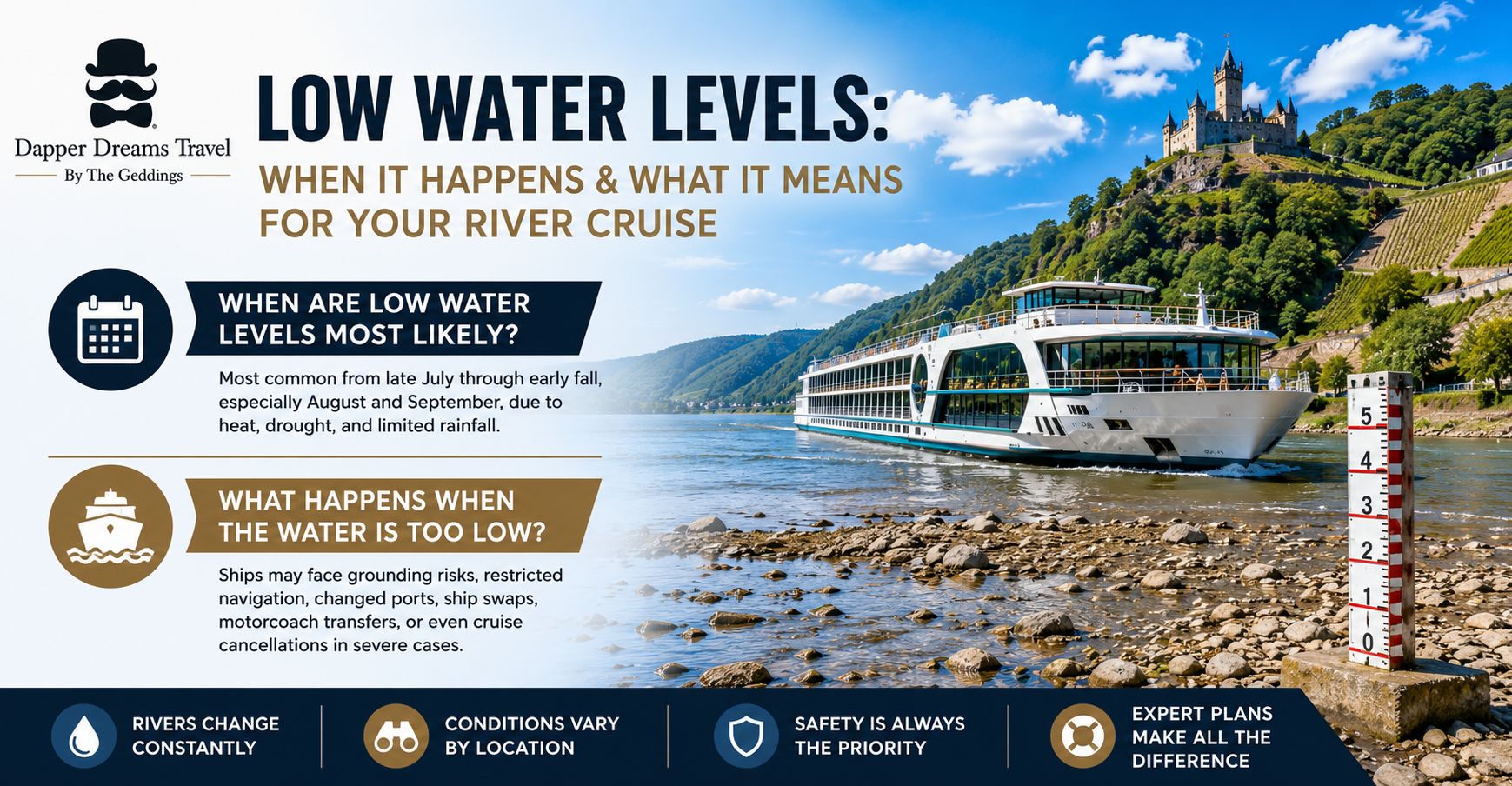
Low water is most commonly associated with prolonged periods of limited rainfall, high temperatures, and increased evaporation.
The greatest historical potential for low-water conditions is generally from late July through early fall, particularly during August and September. Dry conditions can sometimes continue into October or even affect later-season cruises when rainfall remains limited.
That does not mean travelers should avoid summer and early fall. Thousands of cruises operate successfully during these months each year. It simply means that low water is one of several variables travelers should understand when selecting a departure.
Certain locations are more sensitive than others. On the Rhine, the gauge near Kaub in Germany is frequently watched because of the shallower navigation channel in that area. On the upper Danube, the section between Regensburg and Passau can present challenges during low water. Other localized areas may be affected depending on rainfall and river flow.
What Happens When the Water Is Too Low?
Low water does not necessarily mean a river cruise will be canceled. Cruise lines have several operational options, depending on the severity and expected duration of the conditions.
Before the Cruise
River cruise companies often wait until relatively close to departure before making a final operational decision. Although this can feel frustrating, river conditions can change considerably within several days. Rain falling far upstream may raise water levels later, while a forecasted storm may deliver less rainfall than expected.
If low water appears likely to affect an upcoming sailing, a cruise line may:
- Operate the itinerary as scheduled while continuing to monitor conditions.
- Change the ship assigned to the sailing.
- Reverse the direction of the itinerary.
- Adjust the order of ports or substitute a different port.
- Move embarkation or disembarkation to another nearby location.
- Arrange hotel accommodations and motorcoach transportation for a portion of the journey.
- Transfer guests between two ships positioned on opposite sides of the affected area.
- Cancel the cruise when a reasonable alternative cannot be provided.
Cruise lines generally contact affected guests and their travel advisors directly when a significant modification is confirmed. Viking, for example, maintains a current sailings page and states that impacted guests and their travel advisors will be contacted if travel modifications become necessary.
The available solution will depend on the cruise line’s fleet, the number of ships it has operating on the river, port availability, hotel availability, and the specific section that cannot be navigated.
During the Cruise
If low water develops or worsens after the cruise begins, several scenarios are possible.
A Modified Port Schedule
The ship may remain navigable but be unable to reach one particular port. The cruise line may substitute another destination or transport guests to the originally planned destination by motorcoach.
An Alternate Docking Location
Guests may dock farther from the town center than originally planned. Transfers are then arranged between the alternate docking location and the included tours.
Additional Motorcoach Transportation
Part of the river itinerary may temporarily become a land-based journey. Guests may leave the ship for an excursion, travel by motorcoach around the affected section, and return to the same vessel or continue to another ship.
A Ship Swap
Some cruise lines position similar ships on opposite sides of historically sensitive sections of river. Guests may pack their belongings, tour during the day, and board a sister ship later in the afternoon.
The crew handles the operational logistics, but guests normally need to pack and unpack again. When ships have similar layouts, cruise lines may attempt to place travelers in comparable staterooms.
An Overnight Hotel Stay
If the vessel cannot continue and another ship is unavailable, guests may stay in a hotel while the cruise line continues the itinerary using motorcoaches and guided tours.
An Early End to the Cruise
In more serious circumstances, the cruise may conclude early. The cruise line will communicate the arrangements and any compensation or future cruise credit available under its policies.
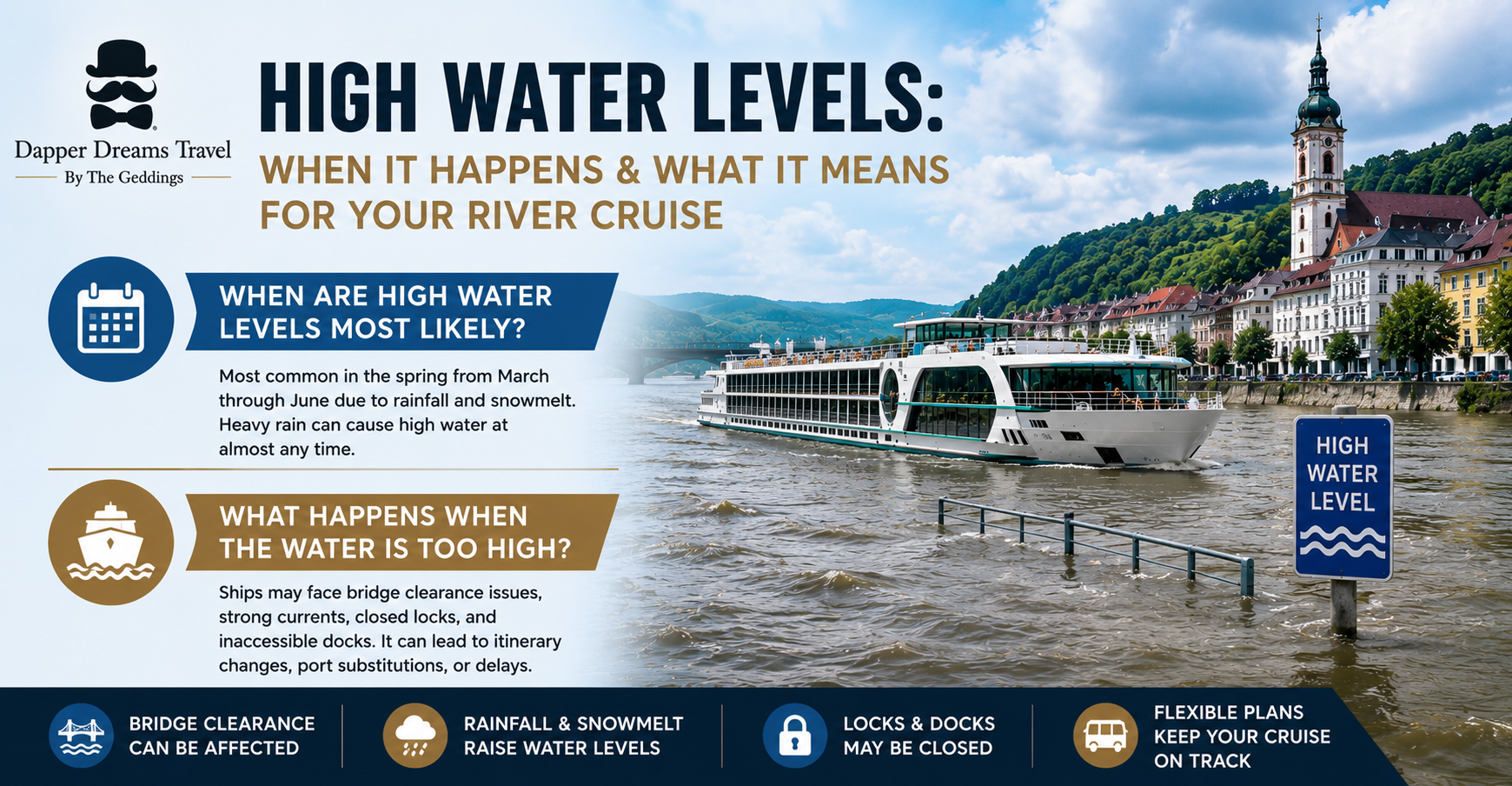
High water is generally more likely during spring, particularly from March through June, when seasonal rainfall combines with melting snow from the Alps and other mountain regions.
Heavy rain can also create high-water conditions at almost any time of year. A slow-moving storm system may cause a river or one of its tributaries to rise rapidly, even when conditions were normal only a few days earlier.
Spring snowmelt and rainfall are commonly associated with higher levels on the Rhine and Danube, while late summer is more frequently associated with low water. These are general seasonal tendencies rather than guaranteed predictions.
What Happens When the Water Is Too High?
At first, it may seem that more water would make navigation easier. In reality, extremely high water can be just as disruptive as low water.
Bridge Clearance
River cruise ships are designed with low profiles, retractable wheelhouses, and upper-deck equipment that can sometimes be lowered. Even with those features, a ship may be unable to pass beneath a bridge when the river rises beyond a safe level.
The ship does not need to run aground to become unable to continue. A bridge with insufficient clearance can stop the vessel’s progress entirely.
Strong Currents
High water often creates faster currents and floating debris. Navigation authorities may temporarily restrict or prohibit vessel traffic if conditions become unsafe.
Closed Locks
Authorities may close a lock because of flooding, excessive current, mechanical concerns, or unsafe differences in water level. A closure can prevent ships from moving between sections of the river.
Inaccessible Docks
A riverside docking location may be underwater, damaged, or unsafe for passengers to use. The cruise line may move to a different dock or arrange transportation from another port.
Before or During the Cruise
The responses to high water are similar to those used during low water. A cruise line may change ships, alter the embarkation point, reverse the itinerary, substitute ports, use motorcoaches, arrange hotels, or cancel a departure when it cannot operate safely.
Safety will always take precedence over following the published itinerary exactly.
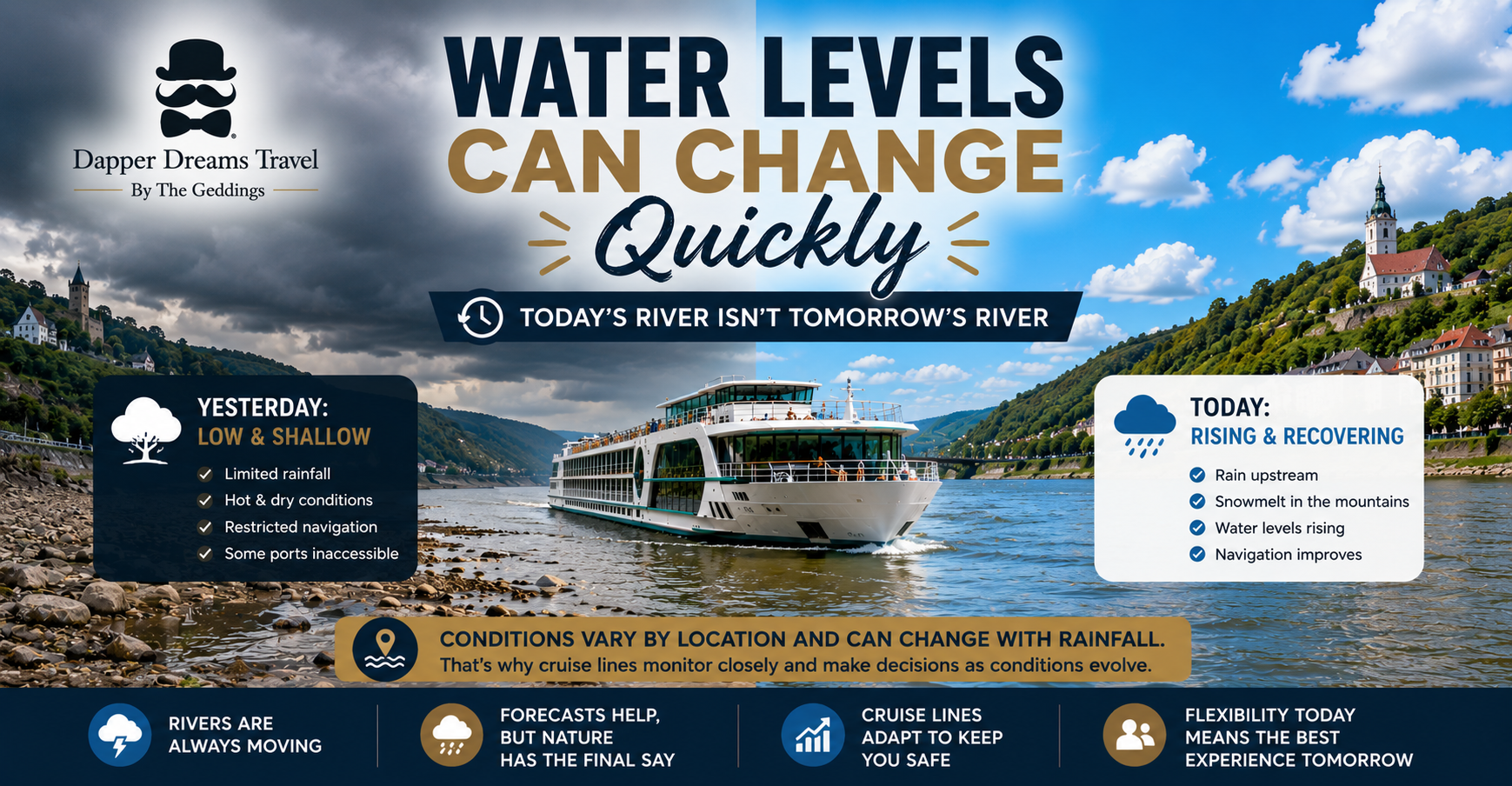
One of the most important things for travelers to understand is that river levels are highly localized and constantly changing.
Rain in Switzerland may eventually influence the Rhine in Germany. Rain or snowmelt in Germany and Austria can affect the Danube farther downstream. The impact may not be immediate because that water must travel through the river system.
A forecast calling for rain does not necessarily mean the river will recover overnight. Conversely, a low reading today does not prove that a cruise departing several weeks from now will be affected.
This is why cruise lines are often reluctant to announce operational changes far in advance. They need reliable information about the river, the weather forecast, the assigned ship, alternate docking locations, and the availability of replacement transportation before communicating a final plan.
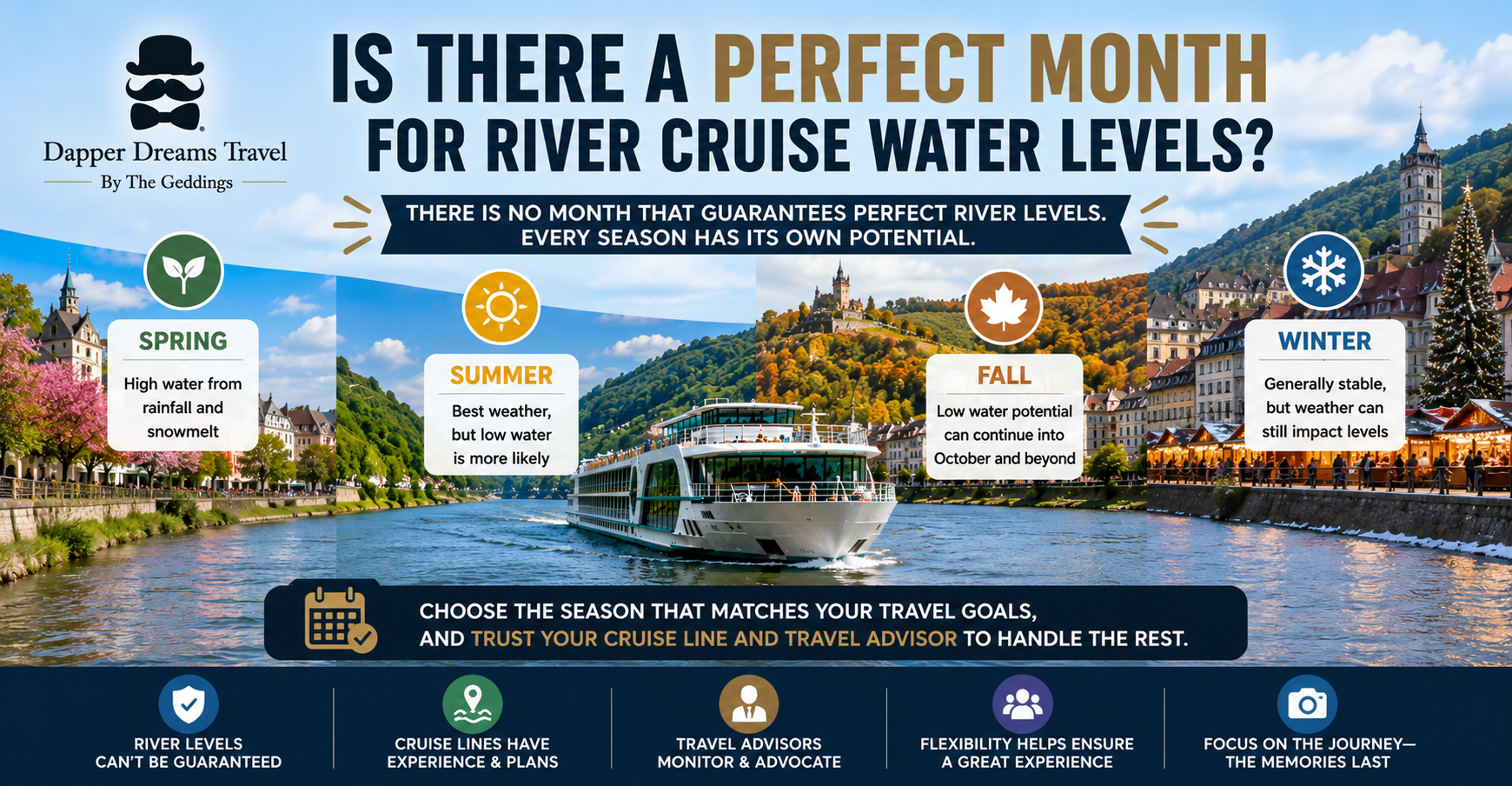
There is no month in which perfect water levels can be guaranteed.
Spring can bring high water from rain and snowmelt. Late summer and early fall can bring low water after heat and drought. Even Christmas market cruises have occasionally experienced low water when dry conditions continued into November or December.
Water levels should therefore be considered alongside the other reasons for selecting a travel date, including:
• Weather and temperature preferences
• Holiday and festival schedules
• Tulip season
• Vineyard and harvest scenery
• Christmas markets
• School and work calendars
• Airfare and cruise pricing
• Availability of preferred ships and staterooms
Choosing a date solely because it is believed to have “safe” water levels can create a false sense of certainty. A better approach is to select the season that best matches the experience you want and book with a cruise line that has strong contingency procedures.
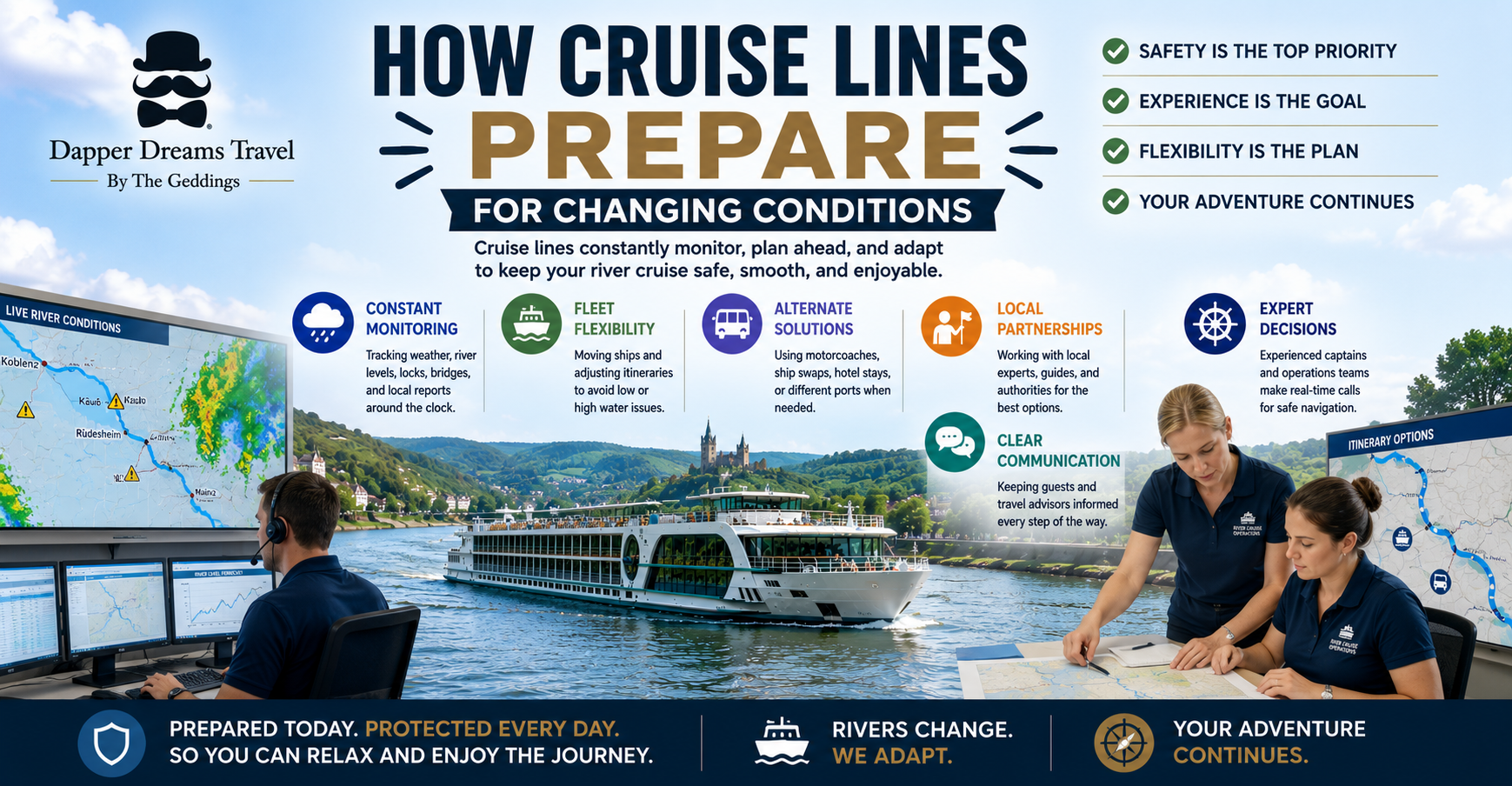
Established river cruise operators have considerable experience managing fluctuating rivers. Their operations teams monitor conditions closely and coordinate with captains, local authorities, port operators, hotels, guides, and transportation companies.
Larger fleets may offer an additional operational advantage because ships can sometimes be repositioned or used for a ship swap. However, no cruise line can guarantee that a particular itinerary will remain unchanged.
Travelers should review the cruise line’s passenger contract and terms before booking. These documents typically allow the company to change ports, ships, schedules, transportation, excursions, or accommodations when circumstances make the original itinerary impractical or unsafe.
Compensation also varies. Depending on the circumstances and cruise line, guests may receive an onboard credit, refund for a missed service, future cruise credit, or no additional compensation when a comparable alternative was provided. Travelers should not assume that an itinerary change automatically entitles them to a full refund.
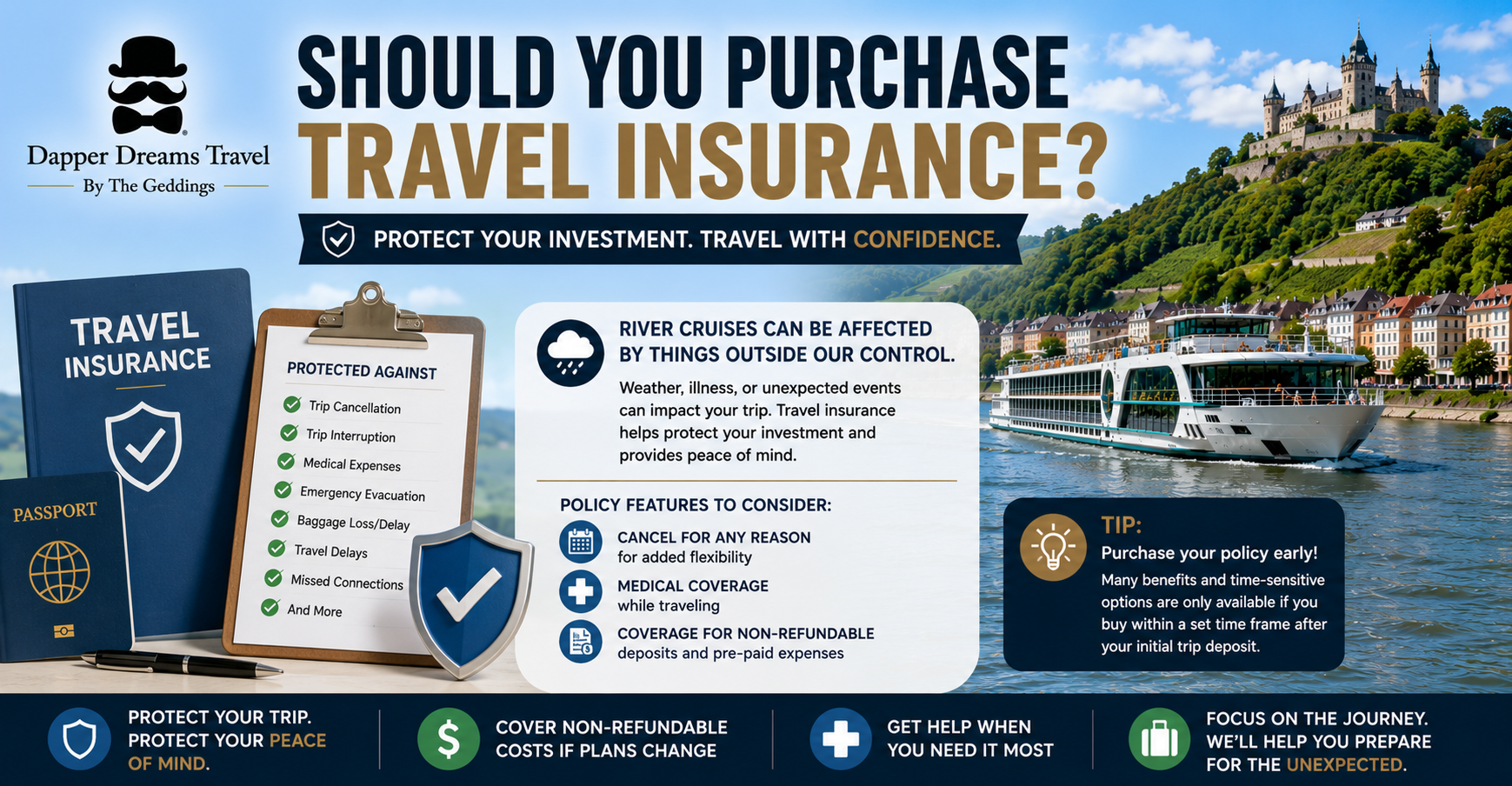
Travel protection is worth discussing for any substantial international vacation, but travelers should understand what their policy actually covers.
Standard travel insurance does not necessarily allow a traveler to cancel simply because river levels are currently low or because they are concerned that an itinerary might change. Coverage generally depends on the specific policy language and whether a listed covered event has occurred.
Cancel For Any Reason coverage may provide more flexibility, but it normally must be purchased within a limited period after the initial trip deposit. It may also reimburse only a percentage of the prepaid, nonrefundable trip cost.
Travel advisors are not insurance adjusters and cannot determine whether a future claim will be approved. They can help travelers compare available options, provide supplier documentation, and direct policy-specific questions to the insurance provider.
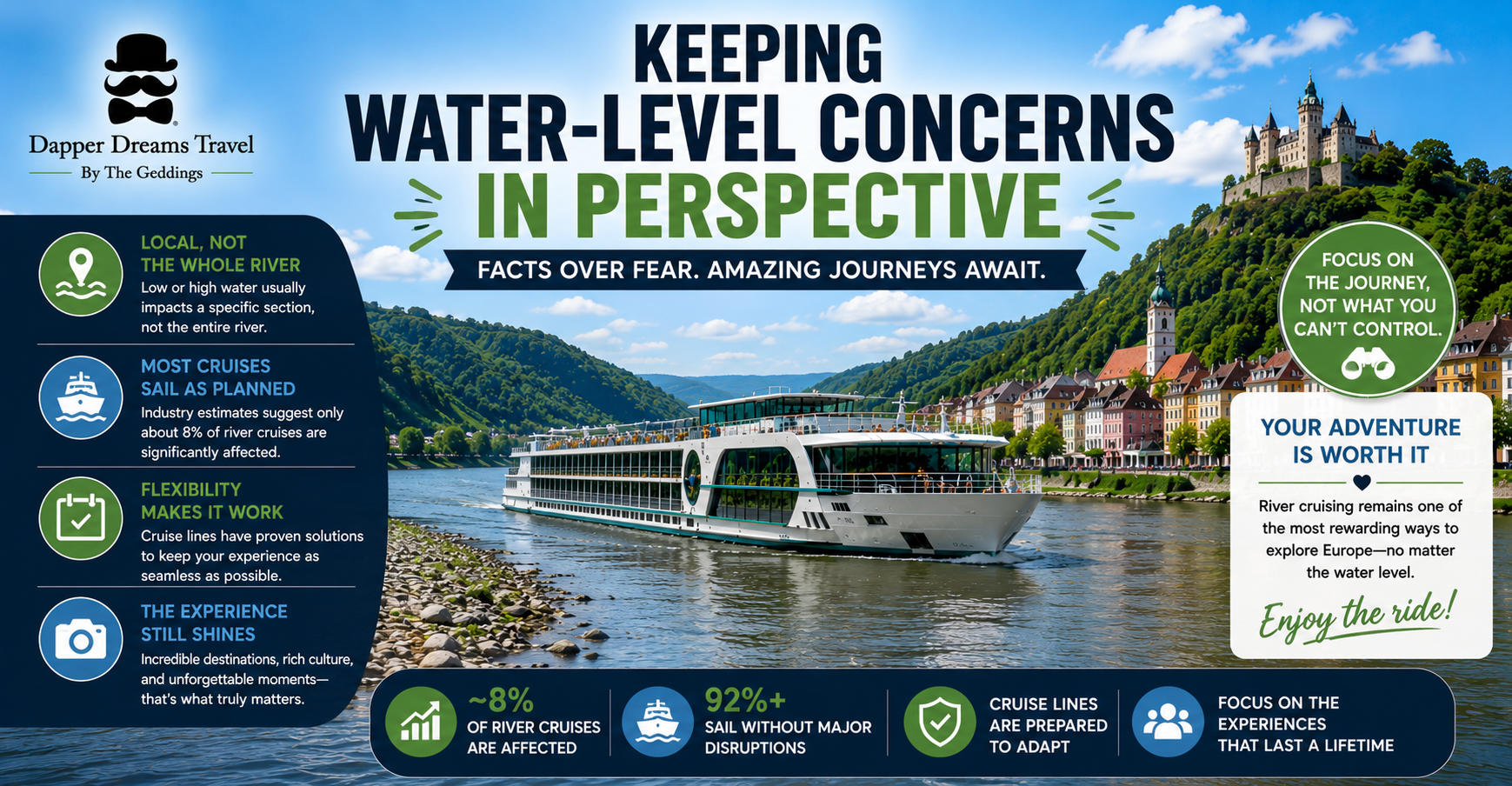
A headline about stranded vessels can make it appear that an entire river has stopped operating. In practice, the situation is usually more localized.
One section may be too shallow while the remainder of the itinerary continues normally. A sightseeing company may suspend its smaller day cruises while some overnight cruise ships remain operational. Cargo vessels may reduce their loads while passenger vessels continue to sail. Another cruise line may cancel because its ship design, fleet position, or itinerary differs from that of a competitor.
There are also varying degrees of impact. A cruise that uses a different dock or changes one excursion has technically been affected, but the guest may still receive nearly the entire vacation experience. That is very different from a cruise that is canceled or converted into a mostly land-based itinerary.
While current conditions in Europe are serious and deserve to be monitored, they do not mean that every Rhine or Danube cruise will be disrupted.

Water-level situations are one of the clearest examples of the value a knowledgeable river cruise travel advisor can provide.
Selecting the Right Cruise Line
River cruise companies do not all handle disruptions in exactly the same way. An advisor who understands the differences among fleets, itineraries, ships, included experiences, and passenger contracts can help match travelers with the company that best fits their priorities.
Monitoring Communications
When conditions become a concern, an advisor can monitor cruise line notifications and contact the appropriate sales or operations representatives for updates.
Travelers may see alarming social media posts about another ship, sailing date, or section of the river. An advisor can help determine whether that information is actually relevant to their specific departure.
Explaining the Alternatives
Terms such as ship swap, alternate embarkation, modified itinerary, and motorcoach transfer can be confusing. An advisor can explain what the cruise line is proposing and how the change may affect the traveler’s overall experience.
Coordinating the Other Parts of the Trip
A change in embarkation or disembarkation can affect flights, hotels, transfers, rail tickets, and privately arranged tours. An advisor can help identify the affected reservations and coordinate necessary adjustments.
This becomes especially valuable when the traveler is already in Europe, dealing with time-zone differences, or attempting to communicate with several companies at once.
Documenting the Situation
An advisor can help maintain records of cruise line notices, itinerary changes, invoices, and unused services. If the traveler needs to contact an insurance provider, that documentation may be important.
Advocating for the Traveler
When a situation is unclear, an advisor can communicate with the cruise line, request clarification, and help ensure that the traveler receives the information and options available under the cruise line’s policies.
An advisor cannot control the weather, change a captain’s safety decision, or guarantee compensation. What an advisor can do is take much of the communication and logistical burden off the traveler.
Instead of spending valuable vacation time calling cruise lines, transportation providers, hotels, and insurance companies, the traveler has an experienced professional helping them understand the situation and determine the next step.
The Bottom Line
Both low and high water are normal operational considerations in river cruising. Low water is more commonly associated with prolonged summer heat and drought, while high water is more frequently connected with spring rainfall and snowmelt.
Neither condition can be predicted with certainty months in advance, and most river cruises operate without a significant water-related disruption.
When water levels do interfere with navigation, cruise lines may modify ports, change docking locations, reverse itineraries, use motorcoaches, arrange ship swaps, provide hotel accommodations, or cancel a departure when no safe and reasonable alternative is available.
The best preparation is not attempting to predict the river perfectly. It is choosing the right cruise line, reviewing the applicable terms, considering appropriate travel protection, remaining flexible, and working with a river cruise travel advisor who can help manage unexpected changes.
River cruising remains an exceptional way to experience Europe. Understanding how water levels are handled allows travelers to approach the journey informed and prepared, without allowing a relatively uncommon possibility to overshadow everything that makes a river cruise so memorable.
You can start planning by visiting us at:
GeddingsTravel.com and clicking Plan A Trip or Vacation Consultation Call.
You can also follow us for cruise insights, travel tips, and inspiration:
Facebook
https://www.facebook.com/DapperDreamsTravelTheGeddings
Instagram
https://www.instagram.com/DapperDreamsTravelTheGeddings
YouTube
https://www.youtube.com/@DapperDreamsTravelTheGeddings